ROLE
Research, UX, Visual System
SCOPE
One Semester
COURSE
AI for UX/UI Designers
TOOLS
Figma Make · Claude Design
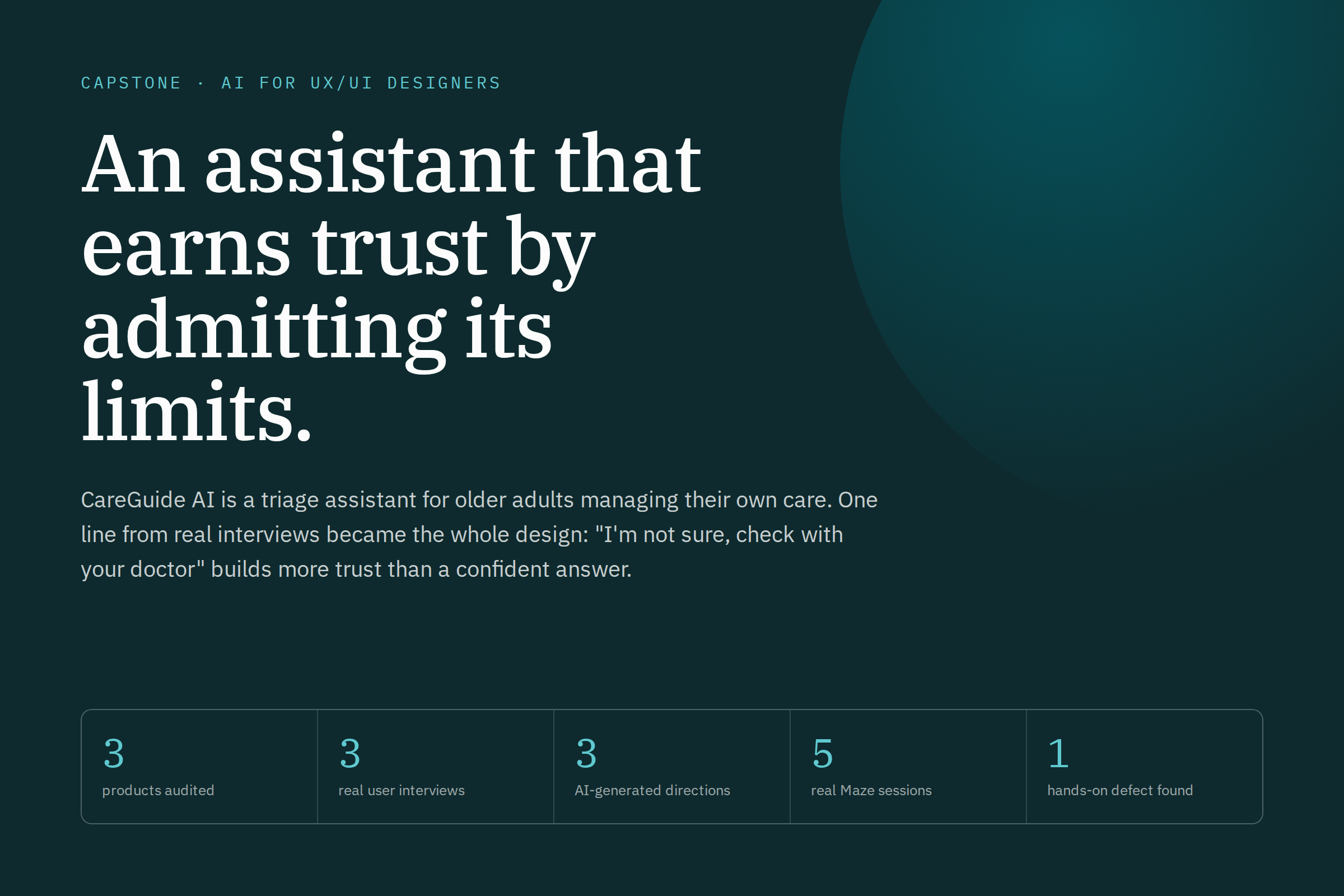
The triage paradox
A competitive audit of three tools people already use for health decisions — scored on accessibility, trust signals, error handling, tone, and cognitive load — found the same structural gap in all of them. No existing assistant holds safety, flexibility, and accessibility at once.
Symptom checker
Ada Health
Structured, clinically grounded triage — but the reasoning behind a result stays mostly hidden from the person reading it.
Gap: confidence without visible provenance.
General assistant
Claude.ai
Fluent, context-aware, genuinely helpful conversation — but no native separation between what's established medicine and what's a generated guess.
Gap: no built-in claim provenance.
Patient portal
MyChart
Authoritative records tied to real providers — but cold, dense, and hard to act on without a clinician translating it.
Gap: trustworthy but not legible.
Six assignments, one triage journey
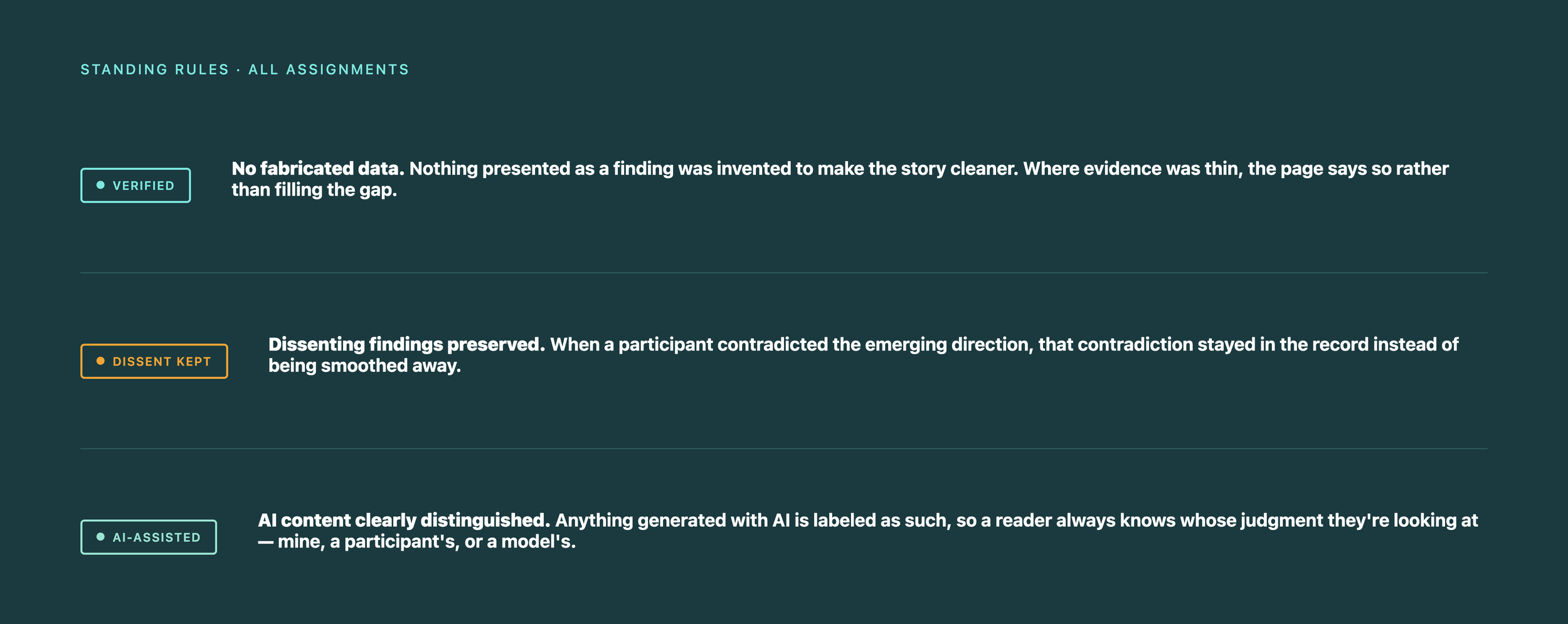
Each stage used AI to move faster, then held the output to a human standard before it carried into the next. Research findings — not aesthetics — drove every interface decision.
-
Competitive research & heuristics
Audited Ada Health, Claude.ai, and MyChart against five criteria, using AI-assisted heuristic scoring. The output was the triage paradox — the gap CareGuide is built to fill.
-
Discovery interviews, AI-assisted synthesis
Three moderated interviews with older adults managing their own care. AI piloted the guide — catching five leading questions before a real person sat down — and helped cluster transcripts. Humans supplied all data. The core finding: admitting uncertainty builds trust; a stated-vs-lived gap means users delegate clerical tasks sooner than clinical judgment.
PERSONA: ELLIE, 71 · PLUS ONE KEPT-VISIBLE EDGE CASE
-
Three AI-generated directions
Prompted Figma Make, grounded in the research, to generate three interaction models for the same journey — conversational chat, guided stepper, and card hub — then compared them side by side instead of committing early. The shipped build fused the card hub as home with the chat flow for the core task.
-
AI-driven style guide
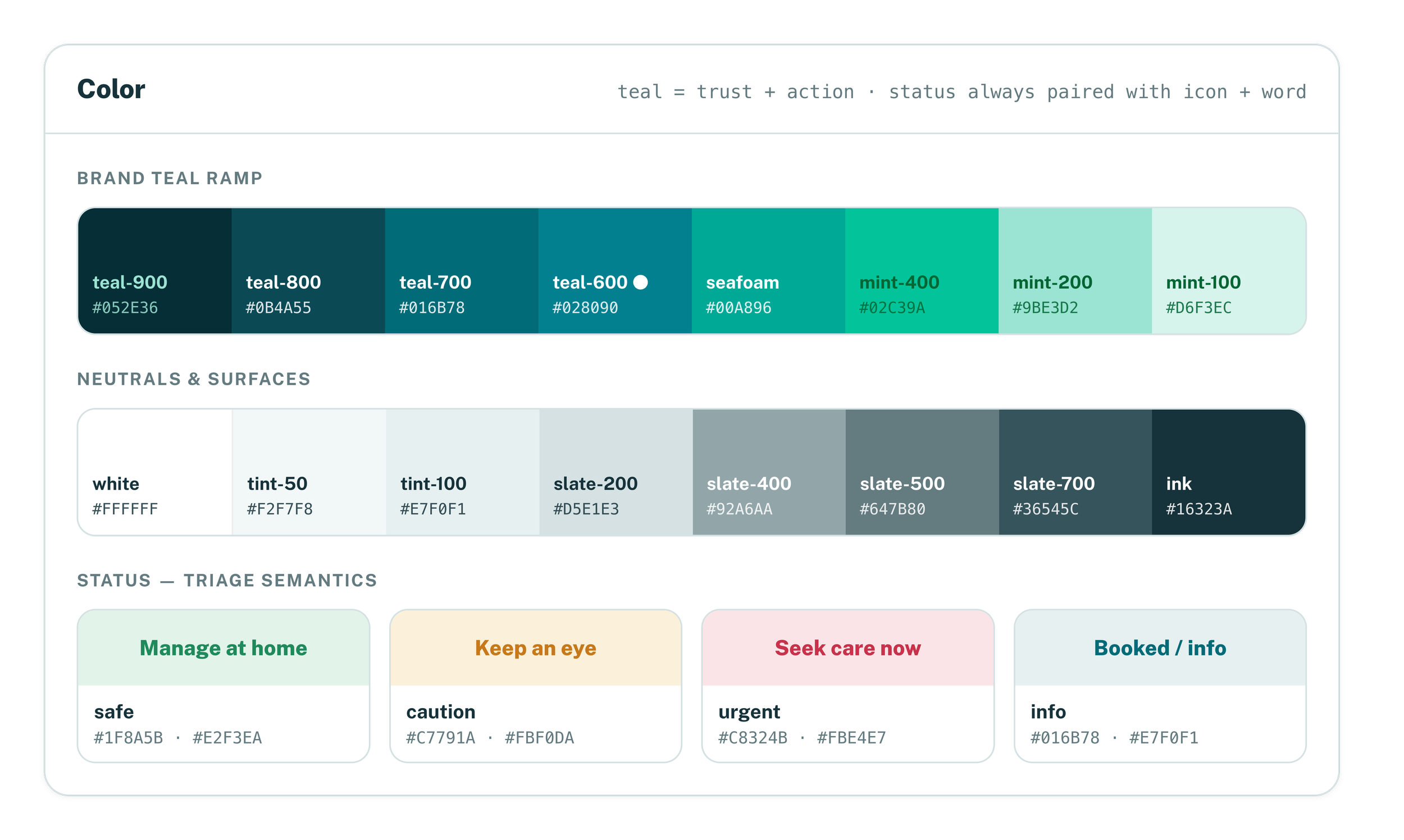
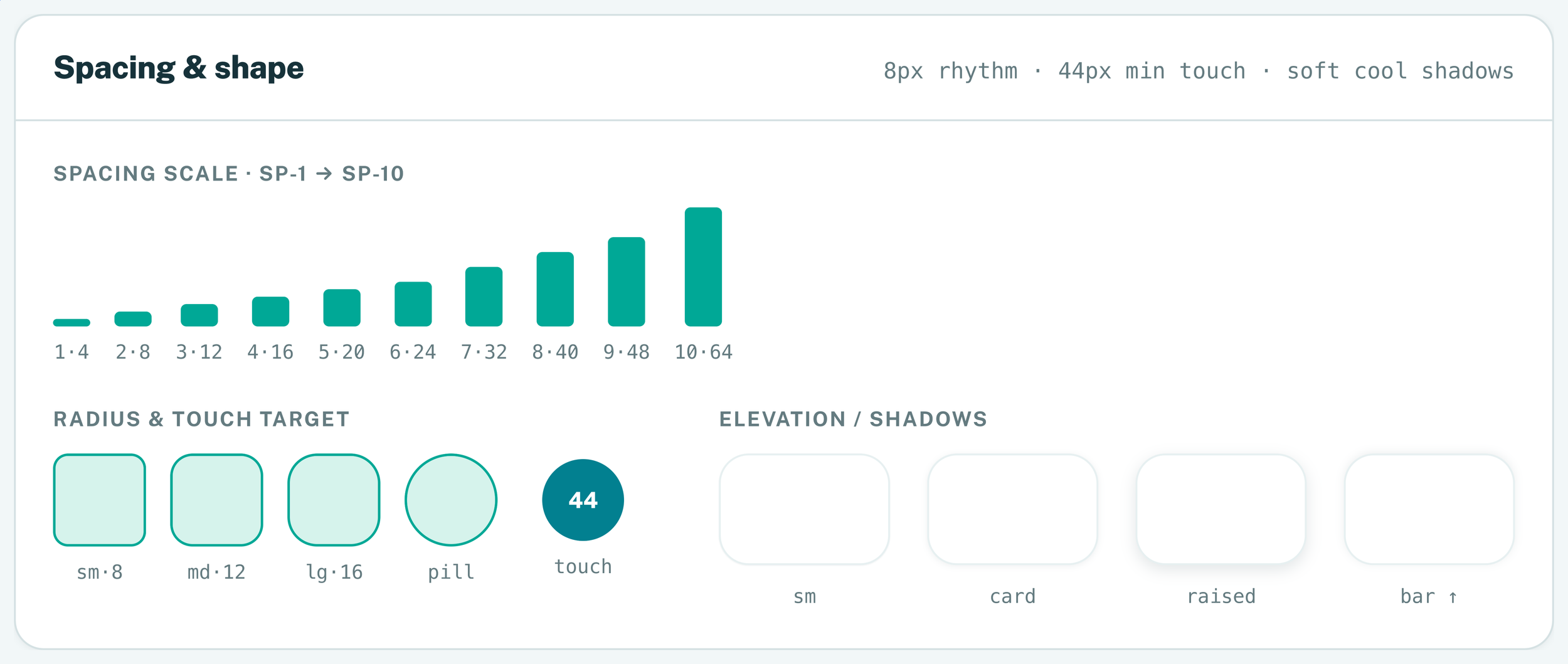
Brand and accessibility tokens encoded "trust calibration" and "constructive friction" as reusable, testable rules: 4.5:1 minimum contrast, 44px minimum touch targets, and color never the only signal — status always pairs with an icon and a word.
-
Usability testing, hands-on and real
The same task run twice: once hands-on against the live build (n=1, every tap by hand), once with five remote testers via Maze. One round caught a specific defect; the other proved real engagement. Neither alone would have found both.
-
Structured prompting for UI
Feeding verbatim brand tokens and rules into a prompt changed the output, not just its polish — the same prompt turned a generic Material button into an on-brand, accessible one. Proof that grounding beats prompting tricks, and that reproducibility is a system, not a lucky prompt.
What real people told me
Three moderated, semi-structured interviews with older adults managing their own care. AI assisted the pilot and the analysis; humans supplied all the data. Findings are labeled by what they actually are — including the participant who diverged, kept visible rather than averaged away.
STRONGEST SIGNAL · 2 OF 3 PARTICIPANTS
Admitting limits builds trust
"I'm not sure, check with your doctor" increased trust. A confident answer to a serious question unsettled users. This became the project's foundational mechanism.
PATTERN
There is no single "AI trust"
Three participants formed three different trust models, tracking their prior AI exposure — triggered by harm, authenticity, and privacy respectively.
BEHAVIOR GAP
Clerical fast, clinical slow
Users delegate logistics — appointments, refills — sooner than judgment. Stated reluctance broke down in practice: a stated-vs-lived gap.
EDGE SEGMENT · FLAGGED, NOT RESOLVED
The confident self-manager
P2, a regular AI user comfortable with ambiguity, wanted help reducing her own medication. Her comfort with confident-sounding answers is exactly what the safety checkpoint has to interrupt — even when it feels like unwanted friction. She's the highest-stakes case the guardrails exist for, so she stays in the findings.
PRIMARY PERSONA
Ellie, 71
Retired · manages her own chronic care · low-to-moderate health literacy · no prior AI-assistant experience · wants larger text and higher contrast.
"If it doesn't know, I want it to just say so."
Trusts CareGuide more when it admits uncertainty. Wants clerical help before anything clinical. Modeled directly on P1 and P3.
METHOD NOTE
P2, a regular AI user comfortable with ambiguity, wanted help reducing her own medication. Her comfort with confident-sounding answers is exactly what the safety checkpoint has to interrupt — even when it feels like unwanted friction. She's the highest-stakes case the guardrails exist for, so she stays in the findings.
Wireframes: Three directions from one flow
Prompted Figma Make, grounded in the Assignment #2 research, to generate three interaction models for the same triage journey — then compared them side by side instead of committing early.
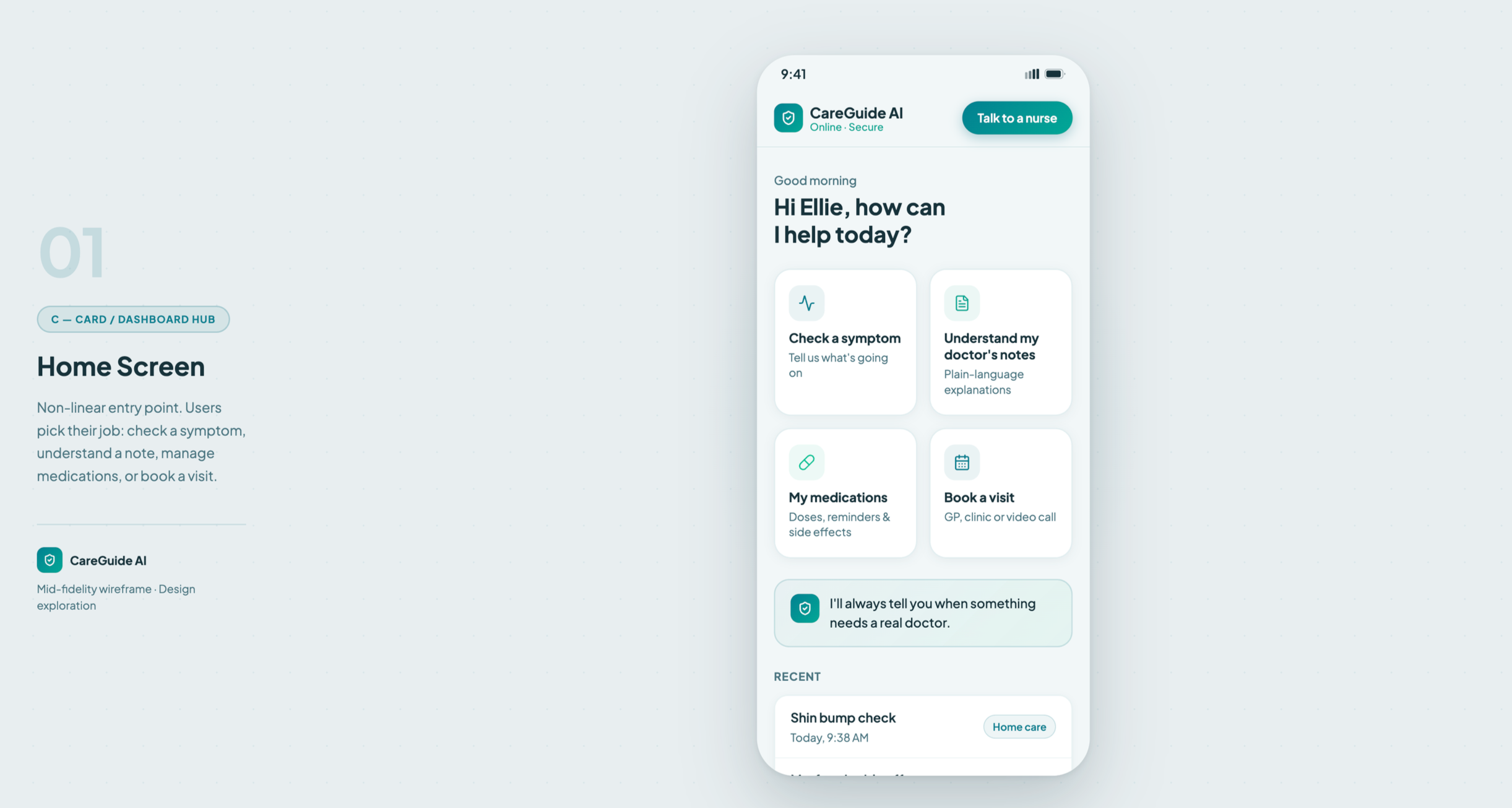
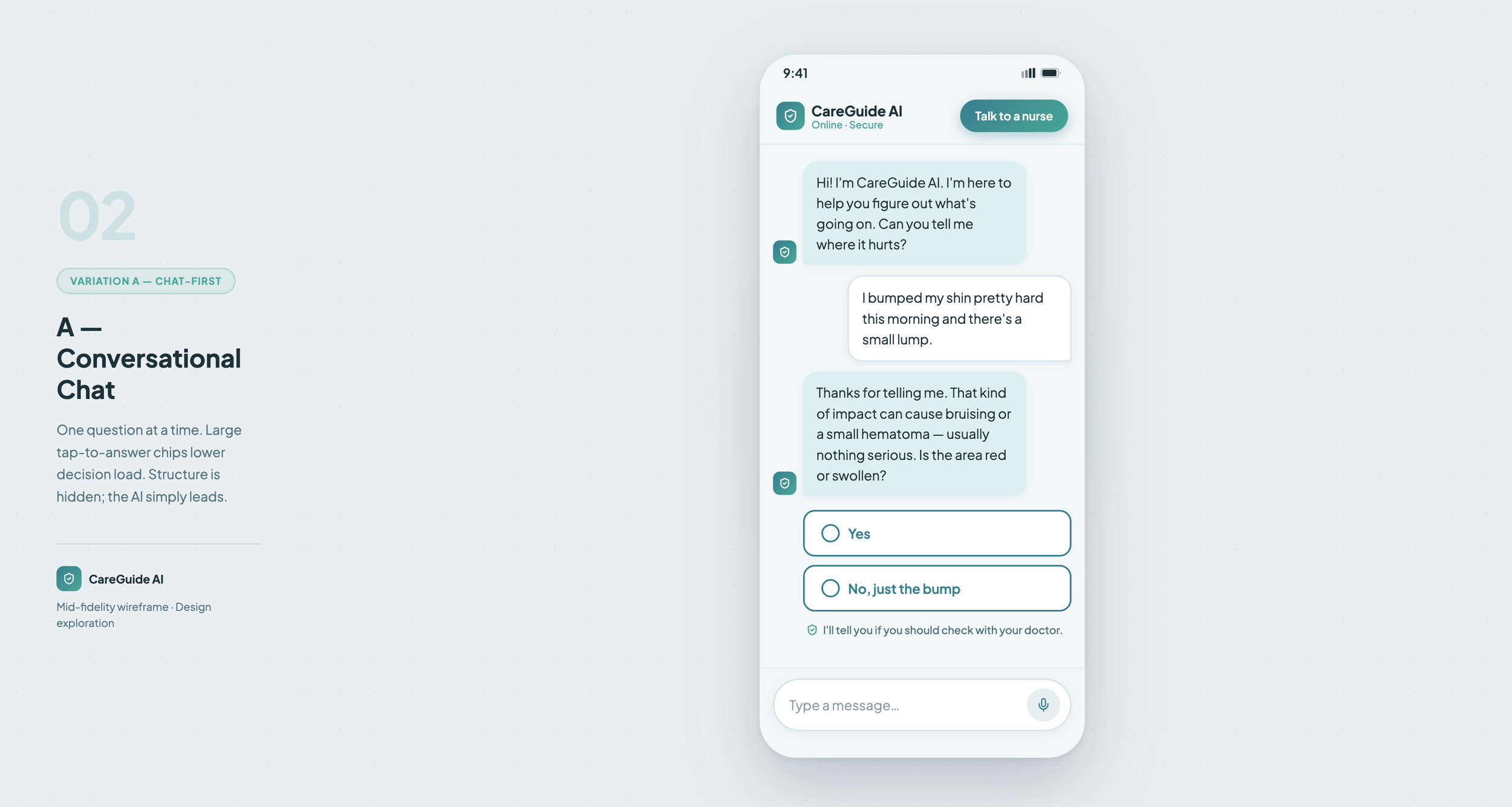
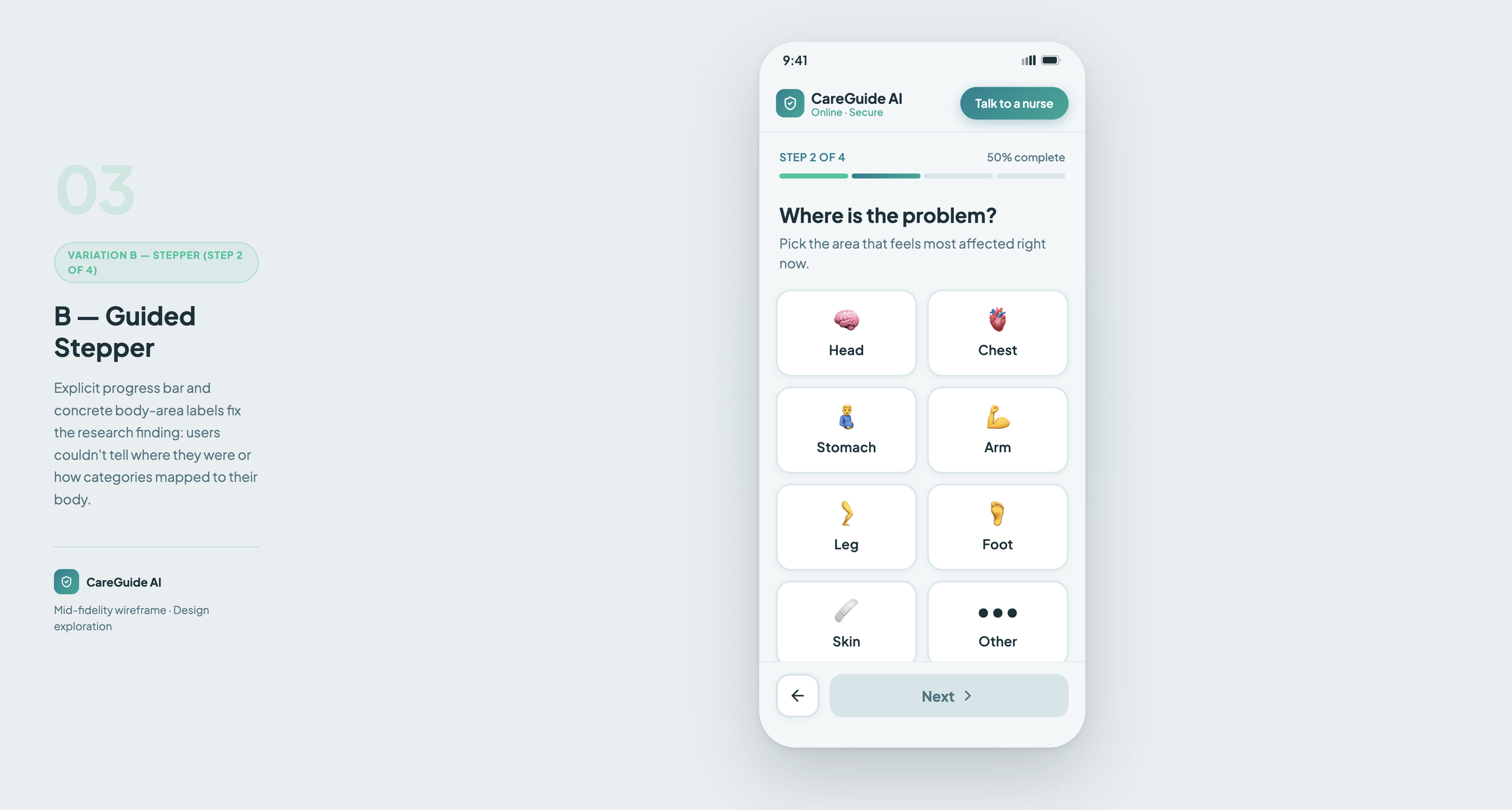
How ideation resolved. The shipped prototype fused the card hub (C) as the home surface with the conversational chat flow (A) for the core task. The guided stepper's concrete labeling (B) carried over into the Body Selector screen.
11 screens across 5 flows
Built in Figma Make across four verified build versions. The case study follows the "Check a symptom" flow — the one given to testers.
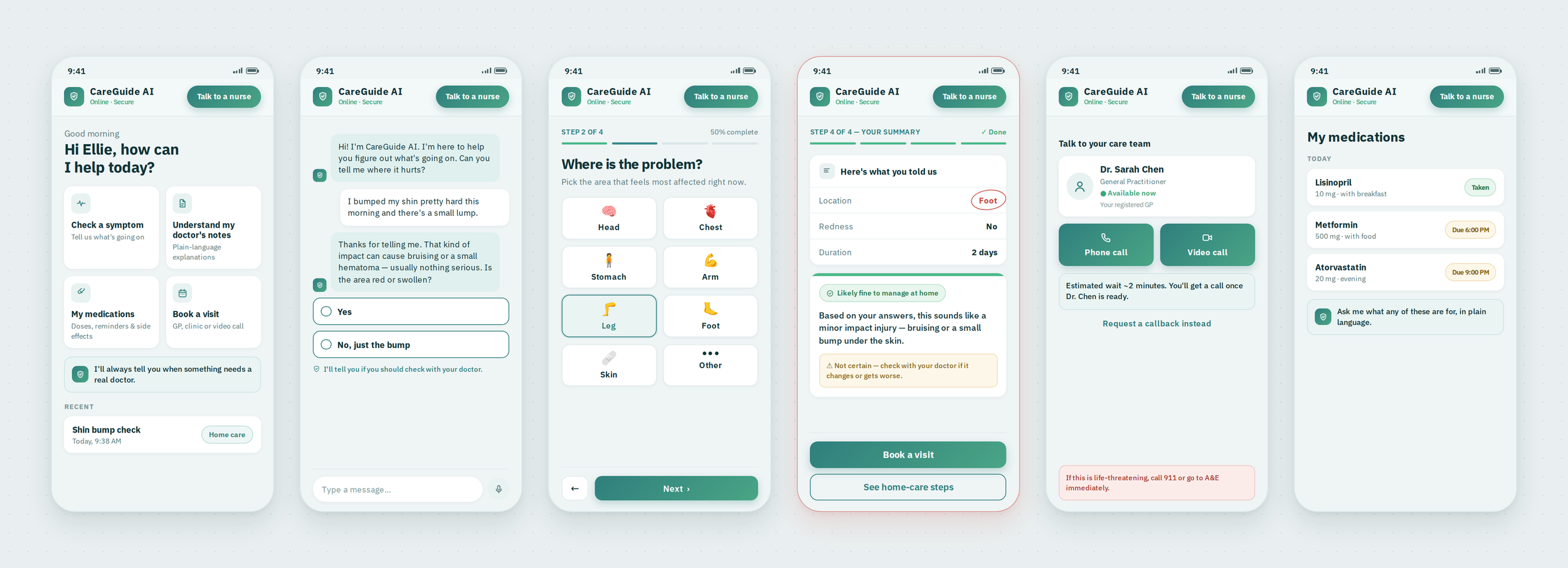
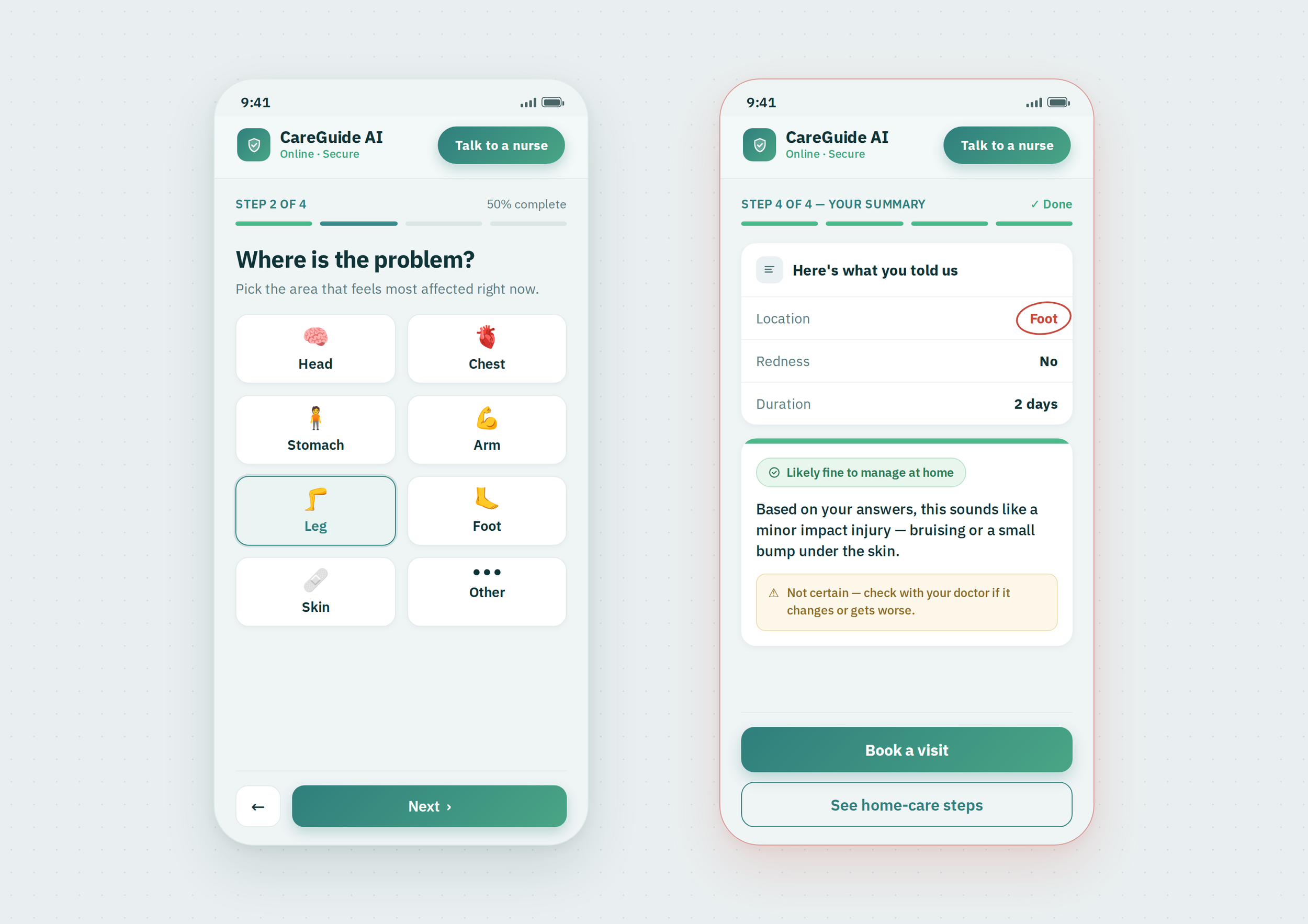
A real defect, found by walking the flow myself
My first attempt at this round built hypotheses from an old flow chart and fictional personas — plausible, but not verifiable. So I redid it: instead of imagining a user, I became one, tapping through the actual live build on the same task given to real testers.
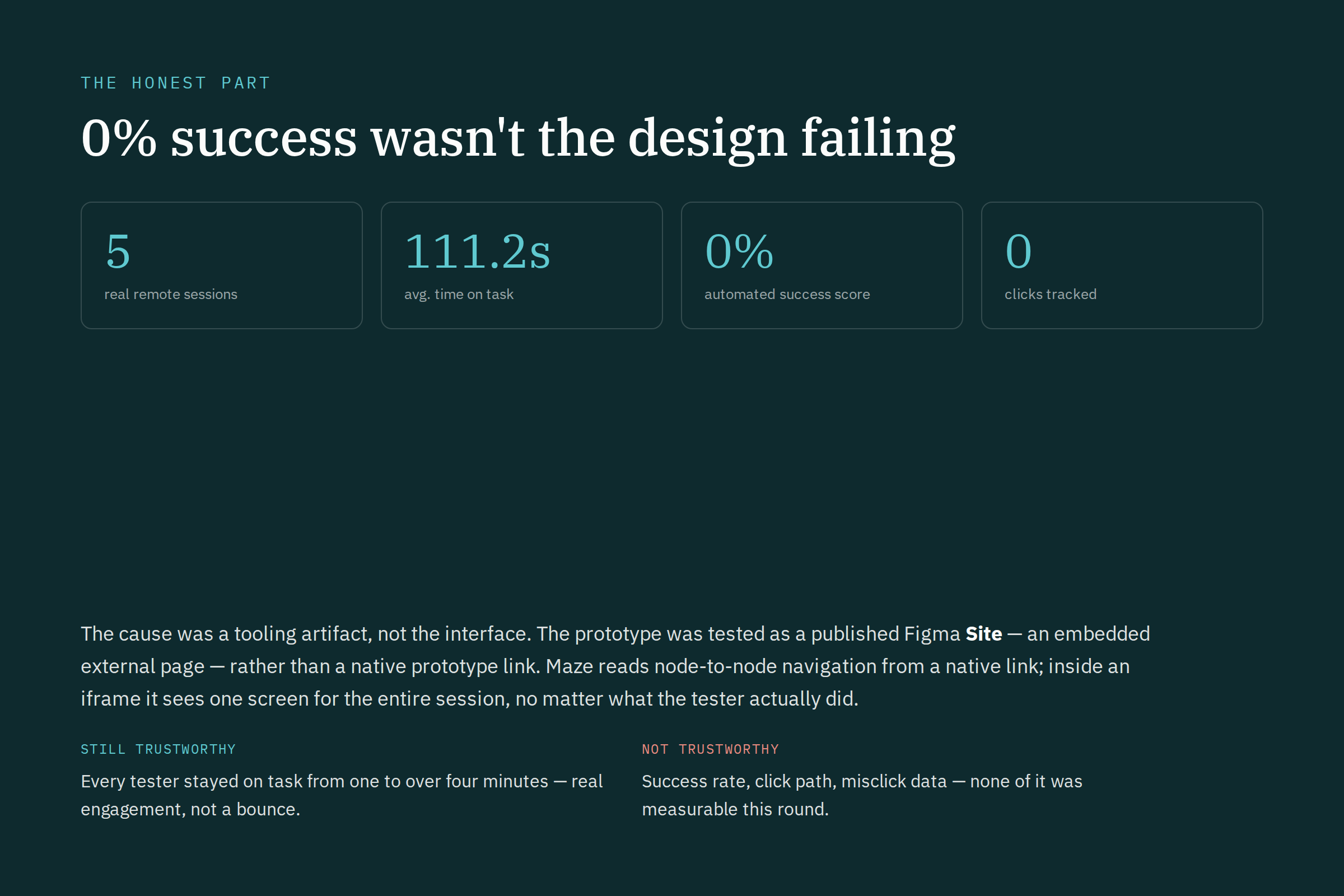
What five real testers could and couldn't prove
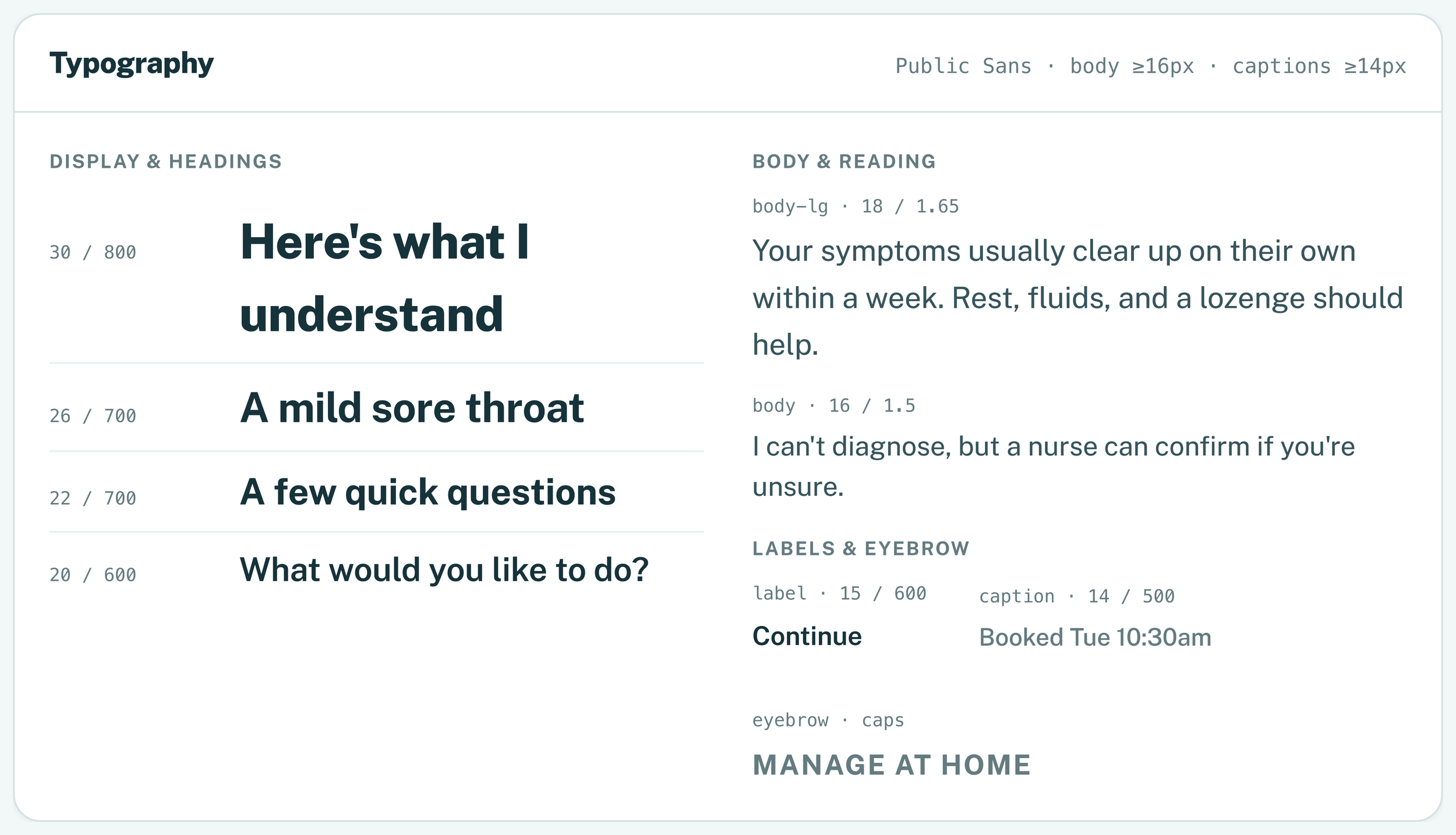
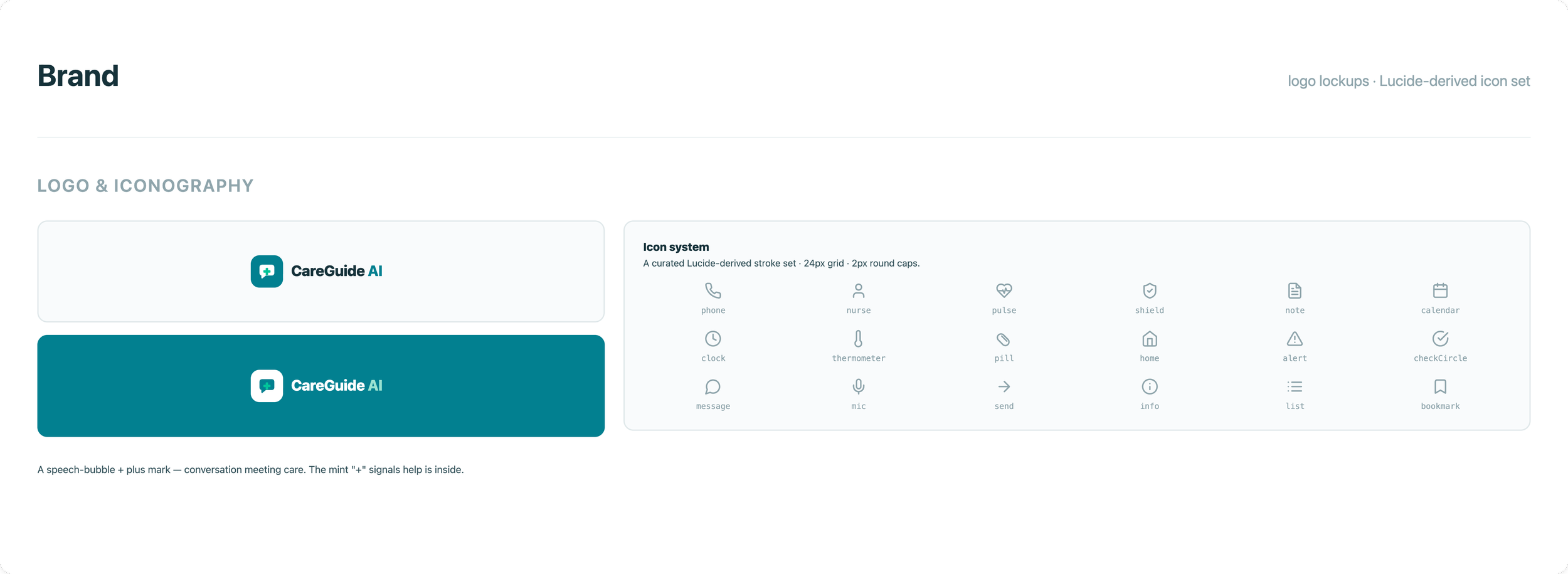
The visual system
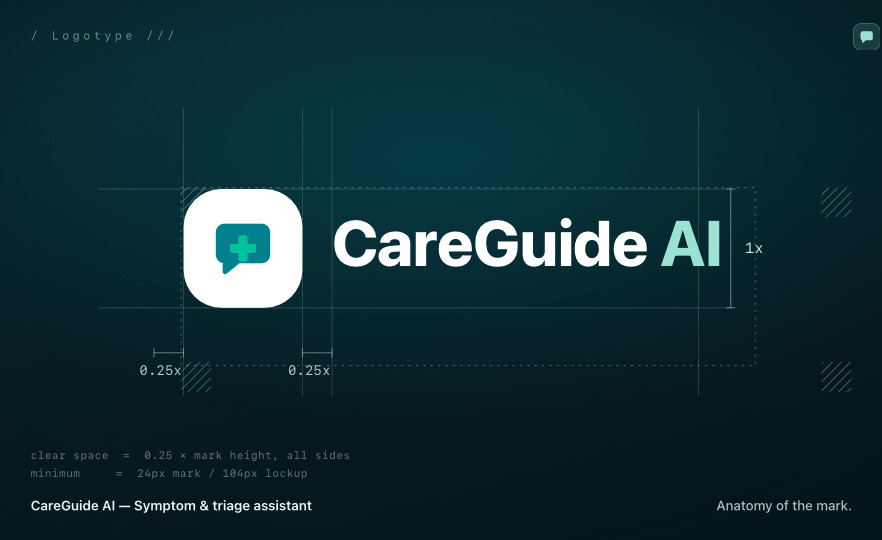
The CareGuide AI visual system is built to feel like a steady hand rather than a hospital form: clinical calm, not clinical cold. Five foundation cards define it — color, typography, spacing & shape, brand, and logo construction — and together they keep every screen legible, unhurried, and trustworthy.